One of the questions people ask when they first discover direct-to-wall printing is whether it only works on white walls. The short answer is no. But if you've ever tried printing a bright image on dark paper, you'll understand why the colour of the wall matters.
A design that looks fantastic on a computer screen can look very different when it's printed onto a dark surface. Colours can lose their brightness, lighter details can become difficult to see, and the finished image might not look anything like you expected.
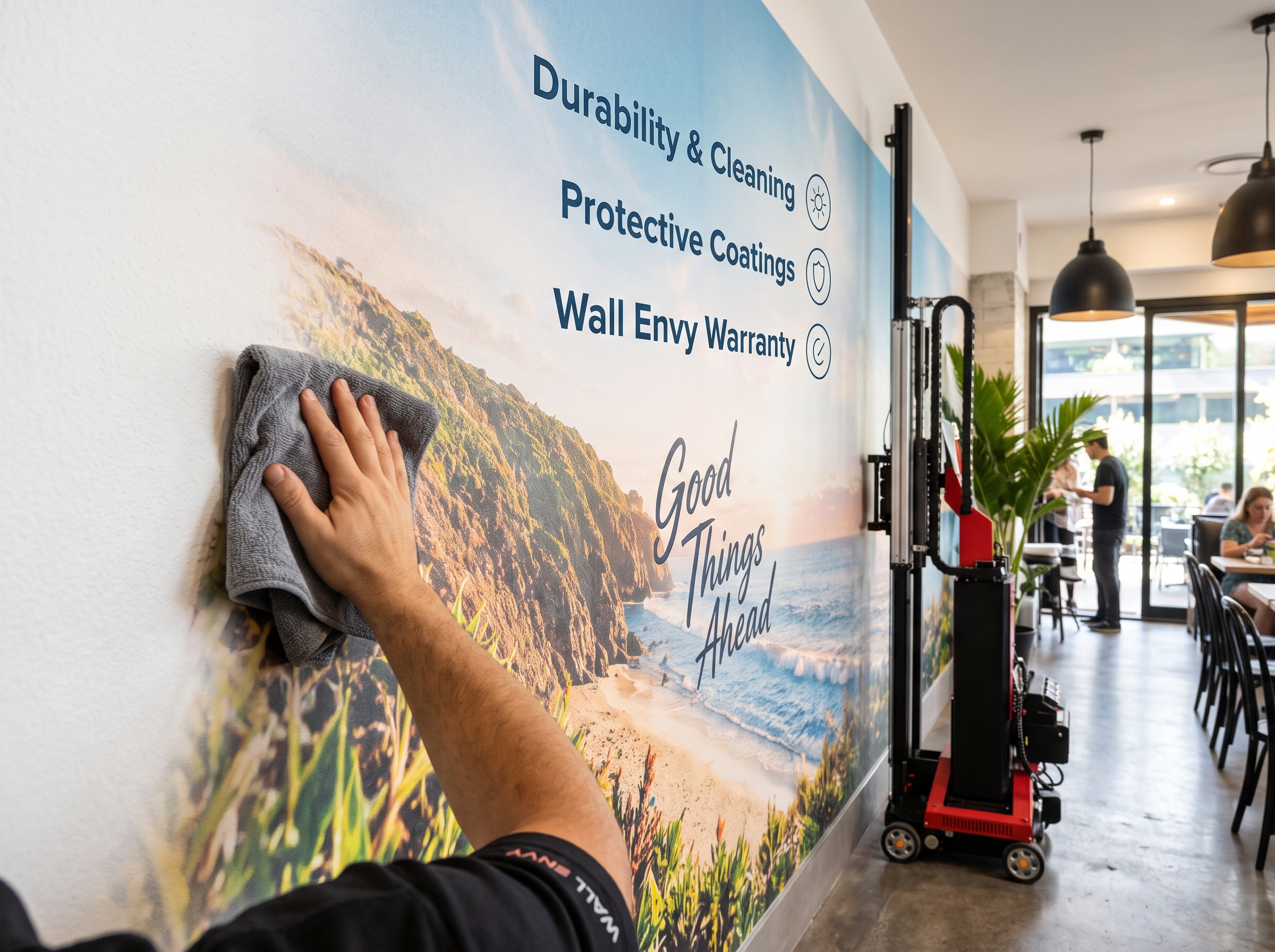
That's where white ink comes in. At Wall Envy, our MK02 direct-to-wall printer uses a CMYK + white ink system. You can see our equipment in action in the friankor-mk01-wall-printer-mk02-wall-floor-printing-modes.webp reference image. This gives us another option when planning artwork for darker surfaces and projects where colour opacity is important. Let's look at how it works and what it means for your wall.
Why does the colour of the wall matter?
Think about printing a photograph on a sheet of white paper. The white background helps the colours appear bright and clear. Now imagine printing that same photograph on dark blue or black paper. The ink hasn't changed, but the result will look different because the background affects the appearance of the colours.
The same principle applies to printing on dark walls. When coloured ink is printed onto a dark wall, the underlying surface can influence how those colours appear. Bright colours may look less vibrant, and details that rely on subtle colour differences may lose some of their impact. This is particularly important for business logos, photographs, colourful graphics and artwork containing white or light-coloured elements.
A dark wall isn't necessarily a problem. It simply needs to be considered when the artwork is prepared.
What exactly is white ink?
Most people are familiar with standard colour printing, which uses four colours: cyan, magenta, yellow and black. These are commonly referred to as CMYK. Our MK02 adds white ink to that mix.
White ink can be used to create a white base beneath selected parts of an image. This is often called a white underbase or white underprint. The idea is straightforward. Where the design needs it, a layer of white ink can help separate the coloured artwork from the darker surface underneath. That can help colours appear more opaque and make certain details stand out more clearly.
It doesn't mean every job needs a complete white layer across the entire wall. The approach depends on the artwork, the wall colour and the result we're trying to achieve. We use this white underbase wall printing technique to create stunning, rich colours, just like the vibrant sea turtle featured in our Dark Wall Printing and Mural Durability-1.png and Wall Envy Printing Guides-2.png images.
What difference can it make?
Imagine a business wants its logo printed on a dark charcoal feature wall behind reception. The logo contains white lettering, bright blue elements and a small amount of gold. Without carefully considering the background, some parts of the design could look different from the original artwork.
With white ink available, we have more flexibility when planning how the design will be printed. The same consideration applies to:
- Company logos and brand colours
- Dark wall murals
- Photographic artwork
- School logos and feature graphics
- Retail and hospitality branding
- Designs containing white lettering or fine details
The important thing is to assess the complete design rather than assume that every colour will reproduce identically on every surface.
Can you print white onto a dark wall?
Yes, direct-to-wall printing white ink is one of the most useful features of our system. It can be used for white lettering, logos, highlights and other elements where white is part of the design. This is particularly useful when a business wants its branding to stand out against a darker background rather than repainting the wall white first.
However, the final result still depends on the surface, artwork, print settings and preparation. Very fine details and small lettering need particular care because the physical print has limitations that don't exist on a computer screen. For important branding work, it's worth reviewing the artwork at the intended print size before the job begins.
Does white ink mean you can print on any dark surface?
Not automatically. White ink helps address the issue of colour opacity, but it doesn't solve every possible surface problem. The wall still needs to be suitable for printing. Its coating, condition, texture and cleanliness all matter.
A sound, properly prepared painted wall is very different from one with flaking paint, moisture problems or an unsuitable coating. The same applies to materials such as brick, concrete, glass, timber and metal. Each has its own considerations, and suitability needs to be assessed for the particular project. In other words, white ink is a genuine Wall Envy capability that gives us another tool to work with, but it doesn't remove the need to assess the wall itself.
Do you need to repaint a dark wall before printing?
Not necessarily. In some cases, the existing wall colour can remain exactly as it is. The artwork can be designed around the background, with white ink used where appropriate to help particular elements stand out. Sometimes the wall colour can even become part of the overall design.
There isn't one rule that works for every project. That's why we'd rather look at the actual wall and artwork before recommending a solution.
Our Services →
Is white ink useful for businesses?
It can be, particularly when branding needs to work with an existing interior. Think about a cafe with dark-painted brick, an office with charcoal walls, a gym with a black feature wall or a retail space with a strong brand colour. Repainting the entire wall to suit the artwork may not be necessary.
Being able to provide reliable white ink wall printing Australia wide gives us more options when preparing a design for those environments. For businesses around the Central Coast, Newcastle, Lake Macquarie and the Hunter, this can be worth considering when planning a reception feature, branded meeting room, hospitality mural or retail interior.
What should you do before printing on a dark wall?
If you're considering a dark-wall mural, we'd suggest starting with three things:
1. Take a photo of the wall. Try to capture the whole area in reasonable lighting, including any nearby corners, windows, doors or fixtures.
2. Find the artwork or logo you want to use. Even if it's only an early idea, it helps us understand the colours, detail and overall effect you're aiming for.
3. Tell us what the space is used for. A quiet office reception is different from a busy hospitality area or a wall exposed to sunlight and regular cleaning.
With that information, we can start assessing the surface, the available print area and whether white ink is likely to be useful. Sometimes the best place to start is simply showing us the wall.
Other FAQs →
Talk to Wall Envy about your wall →
← Back to Blog