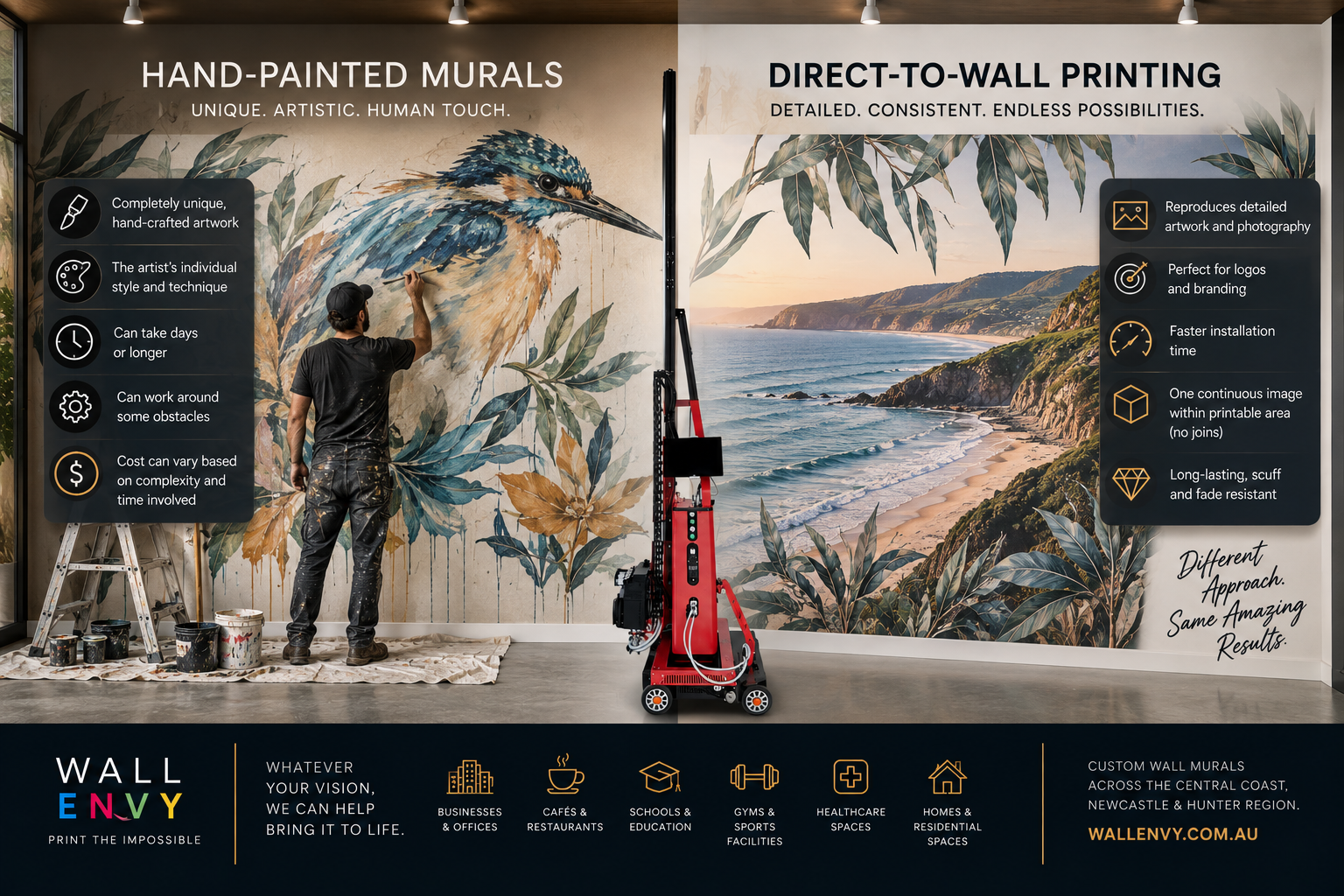
There's something pretty special about watching an artist turn a blank wall into a mural.
A few tins of paint, brushes, maybe a spray gun, a lot of skill — and eventually an empty wall becomes a piece of art.
Now there's another way to do it.
Direct-to-wall printing uses digital printing technology to put artwork directly onto the wall. No wallpaper. No vinyl. And, unlike a traditional mural, no artist standing there painting every element by hand.
So does that make a wall printer better than a mural artist?
Not at all.
They're two very different ways of achieving a similar goal.
And depending on what you want on your wall, either one could be the right choice.
First, what exactly is direct-to-wall printing?
Imagine a very large digital printer standing upright against a wall.
That's essentially the concept.
The printer moves along the wall while a print head travels vertically, building the image directly onto the surface.
There isn't a sheet of material being attached afterwards. The artwork is printed directly onto the suitable wall surface itself.
That means we can start with digital artwork and reproduce it at a much larger scale.
A photograph.
An illustration.
A company logo.
A detailed pattern.
A combination of all four.
Or something completely custom that has been designed specifically for that wall.
And how is that different from a hand-painted mural?
A hand-painted mural is exactly that —
painted by hand.
The artist interprets the design and physically creates it on the wall using brushes, rollers, spray paint or other techniques.
And that human element is part of its appeal.
Look closely at a hand-painted mural and you may see brush strokes, variations in colour and little differences that make the work unique.
A wall printer works differently.
It reproduces a digital file.
That's an important distinction because it means the real question isn't:
Which one is better?
It's:
What do you want the finished wall to look like?
Where direct-to-wall printing really shines: detail
Imagine you want to put a photograph across a large reception wall.
It contains faces, fine textures, shadows, gradients and hundreds of tiny details.
A talented artist could interpret that photograph as a mural.
But they're still interpreting it.
A digital wall printer is reproducing the digital artwork.
That makes wall printing particularly interesting for photography, detailed illustrations, intricate graphics, typography and business branding where consistency and accuracy matter.
If your company has spent years developing its logo and brand colours, you probably don't want somebody approximating the logo by eye.
You want the artwork reproduced from the supplied digital file.
But there's something a mural artist can do that a printer can't
A mural artist isn't a machine.
That sounds obvious, but it creates a very real advantage.
An artist can physically work around architectural features.
They can move around a corner.
They can paint close to a ceiling.
They can work around certain obstacles.
They can alter what they're doing as the mural develops.
Our wall printer can't suddenly decide to squeeze itself behind a pipe.
It needs physical space to operate.
There are limits around ceilings, floors and adjoining walls, and obstructions such as pipes, conduits and fixtures can restrict where the printer can reach.
That's one of the reasons we're very careful about assessing a wall before saying it can be printed.
Sometimes the architecture itself may make a hand-painted mural the better solution.
And that's fine.
What about really large walls?
This is where both options become interesting.
A talented mural artist can create enormous pieces of artwork.
So can wall-printing technology, provided the wall and site conditions allow the equipment to operate.
The difference is largely in
how the artwork gets there.
With a painter, the artwork is progressively created by hand.
With wall printing, the creative work largely happens beforehand.
The design is developed digitally, prepared at the correct proportions and then reproduced onto the wall.
For a business, that predictability can be useful.
You can approve the artwork before printing begins.
There shouldn't be a moment halfway through the job where you're standing there thinking:
"I'm not sure that's what I imagined."
Which gives you more creative freedom?
This one's almost impossible to call.
A great mural artist can create something completely original.
So can a great graphic designer.
They're just working with different tools.
Wall printing gives us the ability to combine things that would be extremely time-consuming to reproduce manually.
Photography can meet illustration.
A company logo can sit within artwork.
Historical images can be combined with modern graphics.
Text, textures, patterns and tiny details can all exist in the same piece.
But if what you want is the unmistakable character of something painted by a human hand, then that's exactly what you should commission.
We don't think technology makes artists obsolete.
It simply gives customers another option.
Our Services →
What about business logos and branding?
This is one area where we'd lean strongly towards digital wall printing.
Logos are designed to be consistent.
The proportions matter.
The typography matters.
The details matter.
Brand guidelines often specify exactly how a logo should appear.
Because a wall printer works from digital artwork, the approved logo file can become part of the wall design.
And it doesn't have to stop at a logo floating in the middle of a blank wall.
Imagine a reception wall where the company logo sits within a much larger photographic or illustrated design.
Or a café wall combining its branding with artwork inspired by the local area.
Or a sporting club wall combining its crest, history, sponsors and imagery into one composition.
That's where direct-to-wall printing becomes much more than another way to make a sign.
Which one is faster?
It depends on the mural.
A small, simple hand-painted design may not take particularly long.
An incredibly detailed mural could take days or considerably longer.
Direct-to-wall printing automates the physical reproduction of the approved digital artwork, which can make it attractive for commercial spaces where the time spent working on site matters.
But there is still work before the printer starts.
The wall needs to be suitable.
The artwork needs to be prepared.
The print area needs to be established.
The equipment needs to be set up correctly.
So we're wary of claims suggesting a wall printer can simply arrive, press a button and magically produce a mural.
There's a bit more to it than that.
Other FAQs →
What about the cost?
This is another question without a simple answer.
A mural artist may price according to the size of the wall, complexity of the artwork, design time, materials and the amount of labour involved.
Direct-to-wall printing also varies according to the size of the print, artwork requirements, wall condition, access and complexity of the job.
Where the difference can become interesting is detail.
A highly detailed image can require an enormous amount of time for an artist to reproduce manually.
With digital wall printing, complexity in the artwork doesn't necessarily translate into somebody having to paint every tiny detail by hand.
But that doesn't automatically mean wall printing is always cheaper.
Every wall is different.
We'd rather look at the actual project than throw out a price that may have very little to do with your wall.
Does wall printing look like a hand-painted mural?
No.
And we don't think it should try to.
You can certainly create digital artwork that has a painted or illustrated style, but they're fundamentally different processes.
A hand-painted mural has the physical character of the artist's technique.
Direct-to-wall printing can deliver extremely detailed digital artwork, photography and graphics.
Neither one needs to pretend to be the other.
What surfaces can be used?
Both methods depend on the surface.
A mural artist may be able to work across surfaces or architectural features that aren't practical for a vertical printer.
Direct-to-wall printing can work on a range of suitable surfaces, potentially including painted plasterboard, brick, concrete, timber, glass, tiles and some metals.
But surface suitability is something we assess.
Texture matters.
Wall condition matters.
Access matters.
Obstructions matter.
And the printer requires clearance around the area it's going to print.
That's why one of the first things we'll often ask a customer for is simply:
"Can you send us a photo of the wall?"
It tells us a lot.
Get in Touch →
So, which should you choose?
If you're looking for something that celebrates the individual style and physical technique of an artist, commission a mural artist.
There are some incredibly talented ones around.
If you're trying to reproduce
photography, detailed digital artwork, typography, precise branding or complex graphics, direct-to-wall printing may make much more sense.
And sometimes the decision comes down to the wall itself.
A printer might suit one wall perfectly.
Another wall might be far better painted by hand.
There's no reason to force the technology onto a project where it isn't the right solution.
A new way to look at a blank wall
Wallpaper, vinyl and hand-painted murals aren't disappearing.
Nor should they.
Direct-to-wall printing simply gives architects, designers, business owners and homeowners another tool to work with.
And we think that's the exciting part.
You don't have to begin by deciding how the wall should be created.
Start with:
What would look incredible here?
Then work out the best way to make it happen.
Got a wall in mind?
Wall Envy provides custom direct-to-wall printing across the Central Coast, Newcastle and Hunter Region, working with businesses, cafés, restaurants, schools, offices, sporting facilities, healthcare spaces and homes.
If you already have artwork, send it through.
If you have a logo and an idea, we can start there.
And if all you've got at the moment is a completely blank wall and you're wondering what could be done with it...
That's enough to start a conversation.
Talk to Wall Envy about your wall →
← Back to Blog