If you want to put a logo, photograph, graphic or large-scale design on a wall, vinyl has traditionally been one of the most obvious choices.
But it isn't the only one.
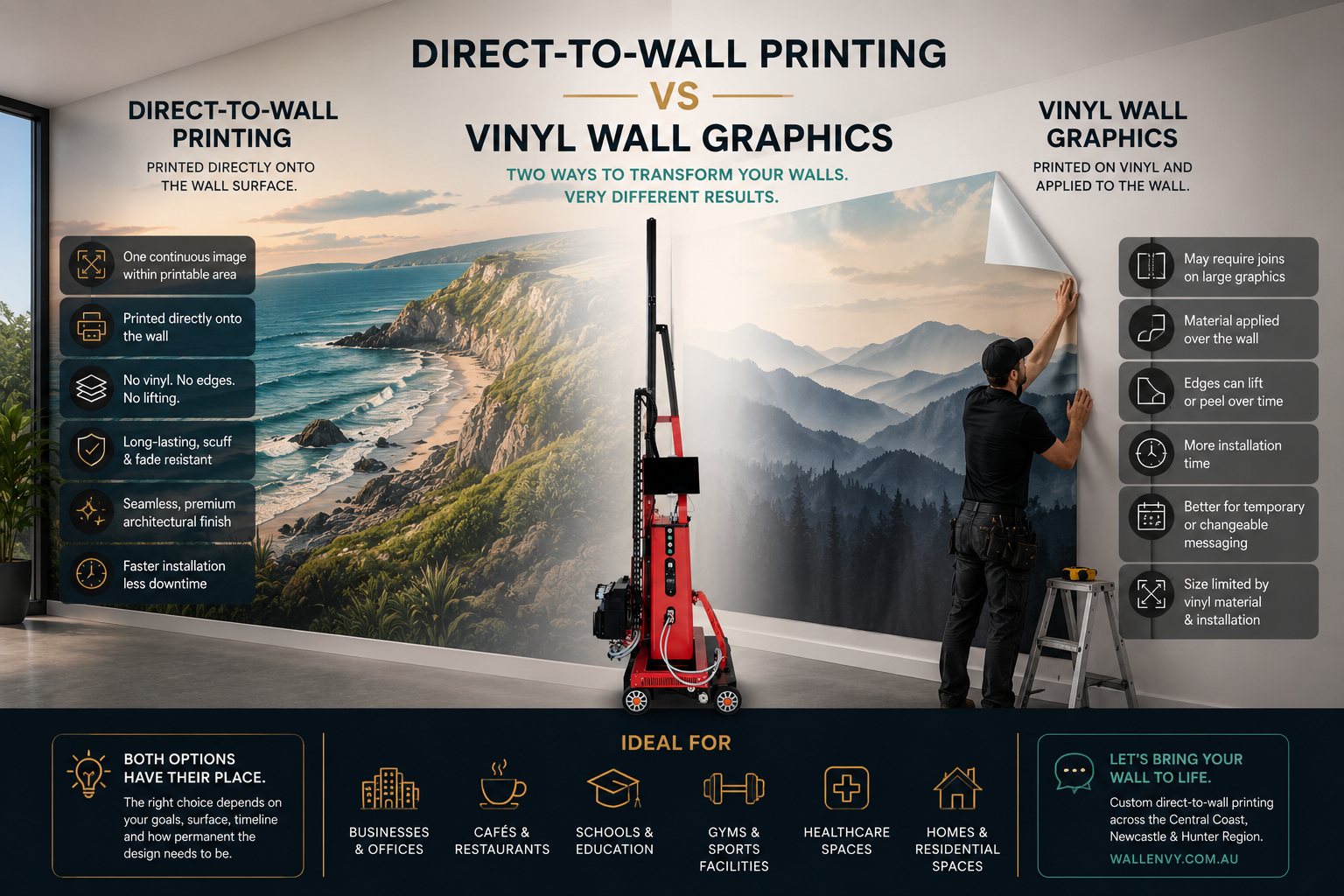
Direct-to-wall printing gives businesses and homeowners another way to create custom wall graphics — except instead of producing the design on vinyl and then sticking it to the wall, the artwork is printed directly onto the wall surface.
At first glance, the finished results can look similar.
The way they're created, though, is very different.
So when should you choose vinyl, and when might direct-to-wall printing be the better option?
Let's compare them.
What are vinyl wall graphics?
Vinyl wall graphics are designs printed or cut from adhesive-backed vinyl.
Once produced, the vinyl is positioned and applied to the wall.
You've probably seen vinyl used for business logos, reception signage, promotional graphics, shop displays, lettering and decorative wall decals.
It's an incredibly versatile product and there are plenty of situations where vinyl is exactly the right solution.
In particular, vinyl can be a good choice for temporary promotions, frequently changing messages and simple signage applications.
Direct-to-wall printing solves a different problem.
What is direct-to-wall printing?
Direct-to-wall printing uses a specialised vertical printer to print digital artwork directly onto a suitable wall surface.
There's no sheet of vinyl between the image and the wall.
The printer travels horizontally along the wall while the print head moves vertically, gradually building the artwork directly onto the surface.
That artwork might be a photograph.
A company logo.
An illustration.
A café feature wall.
School graphics.
A restaurant mural.
Or something designed completely from scratch.
It's essentially large-format digital printing where the wall becomes the print surface.
The fundamental difference: applied graphic vs printed wall
This is the easiest way to understand the two.
With vinyl:
Design → print/cut vinyl → apply vinyl to wall
With direct-to-wall printing:
Design → print directly onto wall
That difference changes both the appearance and the way the finished wall feels.
Vinyl remains a material sitting on top of the surface.
With direct printing, there's no vinyl sheet covering the wall.
For some projects that distinction doesn't matter much.
For others, it's exactly the reason to choose wall printing.
What about joins and seams?
Small vinyl graphics may not require joins at all.
A reception logo, for example, might be produced as one piece depending on its size and design.
But very large vinyl murals can require multiple sections of material.
A professional installer can make these joins extremely discreet.
Direct-to-wall printing doesn't use adjoining rolls or sheets of material.
The printer builds the design directly onto the wall, creating one continuous image within the printable area.
For large photographs, detailed artwork and custom murals, this can create a particularly clean result.
Can direct-to-wall printing print a company logo?
Absolutely — and this is one of the applications we're particularly excited about.
Think about the wall behind a reception desk.
Traditionally, a business might install dimensional lettering, a sign or a vinyl logo.
With direct-to-wall printing, that same wall can become part of the brand.
You could print just the logo.
Or the logo could become part of a much larger design incorporating brand colours, photography, illustrations, a local landmark, company values or other graphics.
This is where direct printing moves beyond simply putting a sign on a wall.
The wall itself becomes the branding.
Which is better for a temporary promotion?
Vinyl will often win this one.
If a retailer wants a promotional message displayed for a few weeks and then removed, an appropriate removable vinyl product may make considerably more sense than printing the wall.
The same applies to frequently changing promotional campaigns.
Direct-to-wall printing is better suited to designs intended to become a more established part of the space.
That's why we see such a strong opportunity for it in reception areas, cafés, restaurants, offices, schools, healthcare environments, sporting facilities and feature walls.
It's important to choose the product based on the job rather than assuming one technology is always better.
Our Services →
Which looks more premium?
That's partly subjective.
High-quality vinyl installed professionally can look excellent.
But direct printing has a different visual character because there's no separate sheet sitting over the wall.
Depending on the surface and design, some of the natural character of the wall can remain visually relevant to the finished piece.
Imagine artwork printed onto a brick wall.
Rather than covering the brick with a sheet, the artwork can interact with the texture and character of the surface itself.
That can produce an effect that's quite different from conventional signage.
For architects, interior designers, cafés, hospitality businesses and creative commercial spaces, that's where things become interesting.
What surfaces can be printed?
This is one of the most common questions we get.
Direct-to-wall printing can work on a range of suitable surfaces, which may include:
- painted plasterboard
- brick
- concrete
- timber
- glass
- tiles
- and some metal surfaces.
But there's an important qualification.
We don't simply say we can print on absolutely anything.
The condition and suitability of the surface need to be considered first.
The printer also requires physical access to the wall.
Pipes, conduits, fixtures and other obstructions can restrict the printable area, and clearance is required around wall boundaries for the machine to operate.
If you're unsure, showing us a photograph of the wall is usually a good place to start.
Other FAQs →
What about textured walls?
This is an area where direct-to-wall printing can become particularly interesting.
Vinyl generally performs best when it has an appropriate surface to adhere to.
Highly textured or irregular surfaces can make vinyl installation more challenging.
Direct printing doesn't rely on an adhesive sheet being bonded across the entire wall.
Depending on the degree of texture, condition of the surface and printer clearance, printing may therefore be possible on surfaces where applying a large vinyl graphic would be less desirable.
Again, the actual wall needs to be assessed.
We're much happier saying "let's look at the wall" than promising something before we've seen it.
What about peeling?
Because direct-to-wall printing doesn't use adhesive vinyl, there isn't a vinyl edge that can begin lifting from the wall.
That's a genuine difference between the technologies.
It doesn't mean that every vinyl graphic peels.
Correctly specified, professionally installed vinyl on a properly prepared surface can perform extremely well.
But adhesives, edges and the vinyl material itself remain part of that system.
Direct printing removes that layer entirely.
Which is faster?
It depends on the job.
Vinyl has to be produced before arriving on site and then installed.
Direct-to-wall printing moves the production stage to the wall itself.
Once the artwork and surface are ready, the printer produces the image directly in position.
For businesses, this can simplify the process considerably.
There are still variables — artwork preparation, wall condition, size, access and complexity all matter — so we'd be wary of making blanket promises about installation time.
Get in Touch →
Can direct-to-wall printing reproduce photographs?
Yes.
And this is one of the areas where digital wall printing really comes into its own.
High-resolution photographs, detailed illustrations, artwork, gradients and complex graphics can all potentially be incorporated into a mural.
That opens up possibilities well beyond traditional business signage.
A café might use a historic photograph of its local area.
A restaurant might commission an illustration unique to the venue.
A school could create a timeline across a corridor wall.
A business could transform a reception area with imagery connected to its story.
A sporting club could combine club history, players, sponsors and colours into one wall.
The technology is really just the tool.
The interesting part is deciding what to put on the wall.
Which is better for business walls?
This depends on what the business needs.
If you need:
Temporary promotional graphics:
Vinyl may be the better solution.
Window signage:
Vinyl can be an excellent option.
Frequently changing offers:
Again, vinyl makes a lot of sense.
But if you're creating:
A permanent reception feature
A large custom mural
A branded office wall
A café or restaurant feature wall
A school or childcare mural
A gym or sporting-club wall
A detailed photographic wall
then direct-to-wall printing deserves serious consideration.
Is wall printing more expensive than vinyl?
This is difficult to answer with a simple yes or no.
The cost of either option depends on the size of the wall, artwork, surface, preparation required and complexity of the installation.
You also need to compare like with like.
A small cut-vinyl logo is very different from a full photographic vinyl mural.
Likewise, a small printed logo isn't comparable to an intricate floor-to-ceiling custom wall design.
Rather than choosing based purely on a square-metre figure, we'd look at:
What are you trying to achieve?
How long do you want it there?
What is the wall surface?
How large is the design?
Is the artwork temporary or part of the permanent interior?
Those answers usually make the choice much clearer.
So, is direct-to-wall printing better than vinyl?
Not always.
And we think that's important to say.
Vinyl is an established, versatile signage product and there are plenty of jobs where we'd choose it.
Direct-to-wall printing becomes particularly compelling when the wall itself is intended to become the artwork.
There's no adhesive sheet.
No vinyl material covering the design area.
No need to restrict the concept to a simple logo or piece of signage.
You can start with a blank wall and create something specifically for that space.
And that's the real difference.
Got a blank wall?
If you've been considering vinyl, wallpaper, signage or a hand-painted mural, there's now another option.
Wall Envy creates custom direct-to-wall printing for businesses, cafés, restaurants, offices, schools, healthcare spaces, sporting facilities and homes across the Central Coast, Newcastle and Hunter Region.
Already have artwork? Great.
Have a logo but don't know what to do with it? We can work with that.
Have nothing more than a big blank wall?
That's a pretty good place to start too.
Talk to Wall Envy about YOUR Wall →
← Back to Blog