If you're planning a feature wall, custom mural or branded space, wallpaper is probably one of the first options that comes to mind.
But there's another option that's still relatively new to many Australians: direct-to-wall printing.
Instead of printing an image onto rolls of wallpaper and then installing those rolls onto the wall, direct-to-wall printing puts the artwork directly onto the wall surface.
So which is better?
The answer depends on what you're trying to achieve.
Let's look at the differences.
What is direct-to-wall printing?
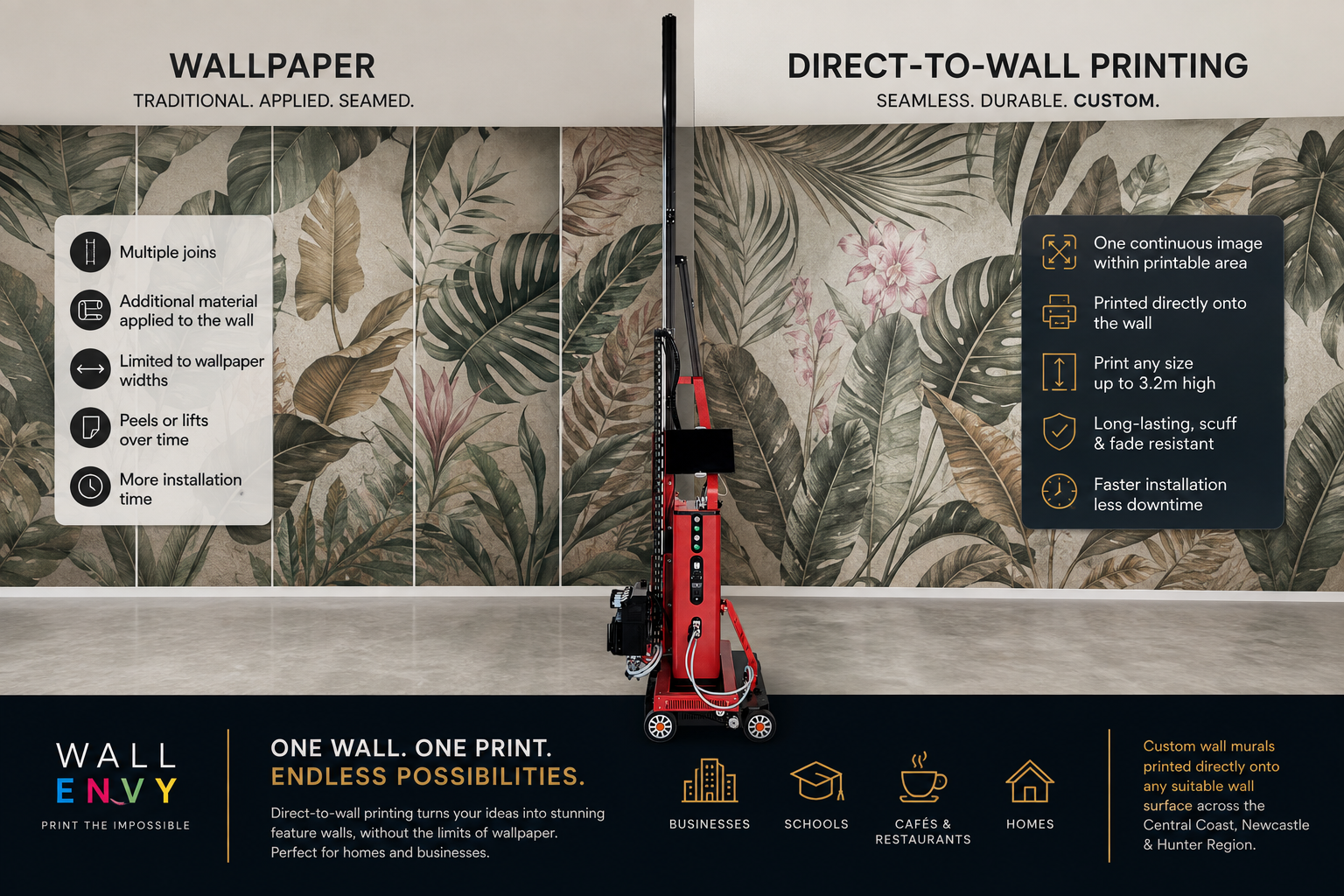
Direct-to-wall printing uses a specialised vertical printer that travels across the wall while digitally printing the artwork directly onto the surface.
Think of a large-format printer turned vertically.
Rather than producing wallpaper, vinyl or a decal that then needs to be applied, the wall itself effectively becomes the print surface.
This allows photographs, artwork, patterns, illustrations, business logos and other custom graphics to become part of the wall without adding another layer of material over it.
At Wall Envy, we use direct-to-wall printing to create custom walls for homes and businesses across the Central Coast, Newcastle and Hunter Region.
What is custom printed wallpaper?
Custom wallpaper works differently.
Your artwork or design is first printed onto wallpaper material. The wallpaper is then supplied in sections or drops and installed onto the wall using adhesive.
Wallpaper has been around for a very long time, and for good reason.
There are thousands of designs available, it works beautifully in many interiors, and a skilled wallpaper installer can produce an excellent result.
But when the goal is a completely custom mural, photograph, logo or large-scale piece of artwork, direct-to-wall printing offers some interesting differences.
The biggest difference: there is no wallpaper
This sounds obvious, but it's actually the fundamental difference between the two.
With wallpaper, you're attaching another material to the wall.
With direct-to-wall printing, we're printing the image onto the wall itself.
That means there's no wallpaper backing and no wallpaper joins running through the artwork.
For a large photographic mural, detailed illustration or company logo, this can create a particularly clean architectural appearance.
What about seams?
Large wallpaper murals generally need to be divided into multiple sections so they can be manufactured, transported and installed.
A good installer can make those joins very discreet, so this shouldn't be interpreted as wallpaper automatically having ugly seams.
Direct-to-wall printing simply approaches the problem differently.
Because the printer creates the artwork directly on the surface, there aren't adjoining strips of wallpaper running through the image.
Instead, the design is produced as
one continuous printed image within the printable area of the wall.
That distinction is especially attractive for detailed artwork, photography and commercial branding.
Can wall printing go right to the edge?
This is an area where wallpaper can actually have an advantage.
Wallpaper can generally be trimmed closely into corners, ceilings and skirting lines.
A vertical wall printer requires some physical clearance around the printable area for the machine and print head to operate.
So direct-to-wall printing shouldn't be described as literally "edge-to-edge".
There will normally be an unprinted margin around certain wall boundaries.
The exact printable area depends on the wall, surrounding obstacles and the equipment being used.
Interestingly, that border can become part of the design.
A mural can be intentionally framed within the wall, creating a very clean, gallery-like appearance.
Which gives you more design freedom?
Both can be highly customised.
But digital wall printing is particularly interesting when you want something completely unique.
A business might want its logo incorporated into a mural.
A café could create artwork based around its location or brand.
A school could combine its crest, house colours, values and educational graphics.
A homeowner might want a favourite photograph, landscape or piece of commissioned artwork transformed into a feature wall.
Because the artwork begins as a digital file, the design can be created specifically around the dimensions and purpose of the space.
You're not restricted to selecting a pattern from a wallpaper catalogue.
Our Services →
Direct-to-wall printing for business branding
This is where we think wall printing becomes particularly powerful.
A blank reception wall is valuable space.
Instead of installing a sign over it, the wall itself can become part of the business's visual identity.
Company logos, brand graphics, maps, illustrations, photographic imagery, company values and feature artwork can all potentially become part of the interior.
The same principle works particularly well in cafés, restaurants, offices, gyms, retail stores, sporting facilities, healthcare spaces and schools.
It's not simply wall decoration.
Done properly, it becomes part of the environment.
What surfaces can be printed?
Wallpaper generally prefers a smooth, properly prepared surface.
Direct-to-wall printing can work across a wider variety of suitable surfaces depending on their condition and the particular application.
That can include surfaces such as painted plasterboard, brick, concrete, timber, glass, tile and some metal surfaces.
However,
not every wall is automatically suitable for printing.
The surface needs to be assessed, and the printer also needs physical access to the area.
Pipes, fixtures, switches, uneven obstructions and other objects on a wall can affect the available printing area.
That's one reason we prefer to look at the actual wall rather than simply tell someone that we can "print on anything."
Other FAQs →
Which is quicker to install?
This depends heavily on the size and complexity of the job.
Wallpaper requires the mural to be produced and then physically installed.
Direct-to-wall printing removes the wallpaper installation stage because the final image is produced directly on the prepared wall.
For commercial customers, that can make direct printing particularly attractive where disruption to the business needs to be kept to a minimum.
However, wall preparation still matters.
A great print won't magically fix a badly prepared surface.
The condition of the wall should always be considered before printing begins.
What happens if I want to change the mural later?
One of the questions we're often asked is whether wall printing damages the wall.
The print isn't a sheet that needs to be stripped away.
When it's eventually time for a change, a suitable wall can generally be prepared and painted over rather than having wallpaper physically removed.
That can be useful for businesses whose branding or interiors change over time.
Is wall printing better than wallpaper?
Not necessarily.
There are situations where wallpaper is absolutely the right choice.
If you've found a wallpaper you love, want a repeating pattern across an entire room, or need material to finish tightly into corners and wall boundaries, wallpaper may be ideal.
But if you're looking for:
- a completely custom mural
- a company logo or branded wall
- large-scale photographic artwork
- artwork designed specifically for your space
- a mural without wallpaper joins
- printing onto a suitable textured or unusual surface
- or simply something different from conventional wallpaper
then
direct-to-wall printing is worth considering.
Get in Touch →
Wallpaper or direct-to-wall printing?
Ultimately, we don't think this should be a battle between the two.
They're different ways of transforming a wall.
Wallpaper remains an excellent interior-design product.
Direct-to-wall printing simply opens up another set of possibilities — particularly when the design needs to be completely custom.
"Wait… you can actually print that straight onto the wall?"
And because many people still don't know this technology exists, seeing a wall printer creating a mural directly onto a wall tends to produce the same reaction:
"Wait… you can actually print that straight onto the wall?"
Yes. That's exactly what we do.
Thinking about a custom wall?
Wall Envy creates custom direct-to-wall printing for businesses, schools, cafés, restaurants, offices, sporting facilities, healthcare spaces and homes across the
Central Coast, Newcastle and Hunter Region.
If you've got a blank wall and an idea — or even a blank wall and
no idea what to put on it yet — we can help develop a concept around your space.
How Direct-to-Wall Printing Works →
← Back to Blog