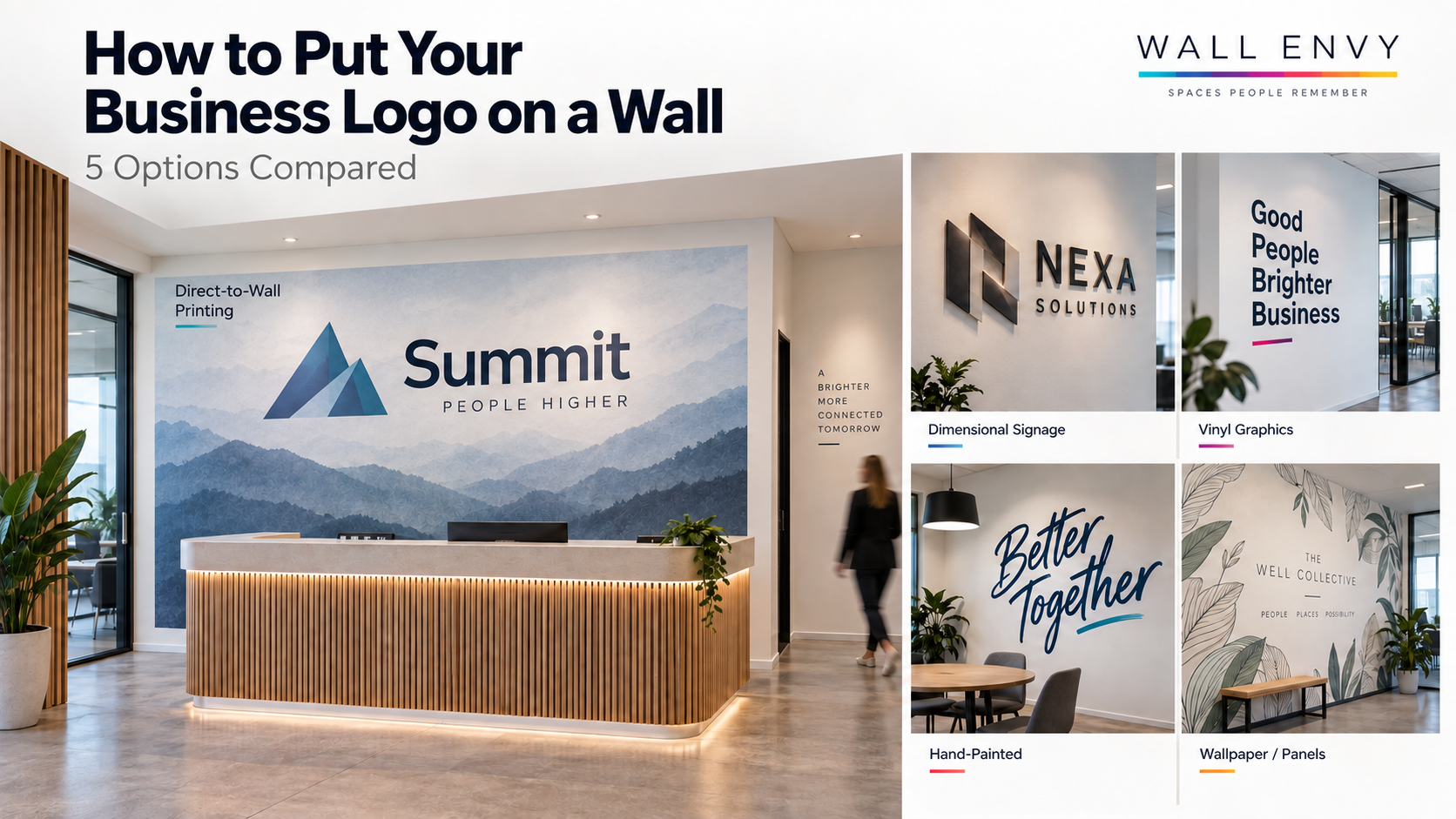
You walk into a business and one of the first things you notice is the logo on the wall. Sometimes it’s subtle, just a neat sign behind reception. Other times it becomes the whole feature of the room.
Either way, that wall is doing more than filling space. It’s telling you where you are, who the business is and, whether you realise it or not, something about how seriously they take their presentation.
If you’re thinking about putting your own business logo on a wall, there are quite a few ways to do it. And they’re not all trying to achieve the same thing.
A raised acrylic sign can look fantastic. Vinyl can be simple and cost-effective. A mural artist can create something completely unique. And now there’s direct-to-wall printing, where the logo or artwork is printed straight onto the wall itself.
So which one should you choose? Let’s look at the main options.
1. Raised acrylic, metal or dimensional lettering
This is probably what most people picture when they think of a reception logo. Individual letters or a complete logo are manufactured from materials such as acrylic, aluminium, stainless steel or other sign-making materials and physically mounted onto the wall.
Done well, it can look extremely professional. For a corporate reception area, especially where the logo needs to stand out from the wall and have a physical presence, dimensional signage is hard to beat. It also gives you the option of lighting the logo from behind or around the edges.
This works particularly well in reception areas, boardrooms, office entrances and retail counters — anywhere you want the logo itself to be the hero.
The limitation is that it is still an object mounted onto the wall. If you want the logo to become part of a much larger piece of artwork, photography or branding, dimensional signage can start to feel separate from the rest of the design. Sometimes that’s exactly what you want. Sometimes it isn’t.
2. Vinyl wall lettering and graphics
Vinyl is another very common way to get a logo onto a wall. The logo is cut or printed from adhesive vinyl and then applied directly to the surface.
For a straightforward logo or lettering job, it can be a very practical solution. It’s also useful when the branding may need to be changed later. A temporary office, a short-term lease, a promotion or a seasonal retail campaign are all situations where vinyl can make a lot of sense.
It works especially well for simple logos, lettering, short-term branding, temporary graphics, glass doors and windows.
The thing to keep in mind is that vinyl relies on adhesive, so the wall surface and preparation matter. Once you move into very large graphics or photographic murals, you may also be dealing with panels, joins and visible edges depending on the application.
For a simple logo, that may not matter at all. For a major feature wall, it might.
3. A hand-painted logo or mural
There’s something genuinely special about hand-painted work. If you choose the right artist, you can end up with a feature wall that has real personality.
You can see the brushwork. You can see the interpretation. It feels handmade because it is.
That makes mural painting particularly strong when the artistic style is part of what you’re buying. A café, brewery, creative studio or hospitality venue might actually want that hand-painted character.
Where it gets more difficult is with highly detailed corporate logos, photography, small lettering, gradients or designs that need exact reproduction. A painted mural can also take considerably longer than a digitally reproduced image depending on the size and complexity.
Again, it really comes down to what you want the finished wall to feel like.
4. Custom wallpaper or printed wall panels
You can also have your company branding produced as wallpaper or a large-format printed wall covering.
This gives you enormous design freedom. You can combine logos, photographs, graphics, patterns and colours into a complete wall design. For large branded interiors, it can look very impressive.
The main difference is that the finished image is still being manufactured on another material first. That material is then installed onto the wall.
Depending on the size of the design, there may be multiple panels that need to be aligned during installation. For some spaces this is completely fine. For others, especially where a seamless finish is important, it becomes part of the decision.
5. Print the logo directly onto the wall
This is where things get interesting for us.
Imagine a reception wall. You could simply print the company logo in the centre — clean, simple and effective.
But you could also incorporate the logo into a complete branded feature wall. Perhaps there’s a photograph of the local area, imagery from the work your company does, a subtle pattern from your brand identity, a company timeline, a map showing where you operate, or even photography of your team or major projects.
The logo becomes one element of a bigger story.
That is where direct-to-wall printing starts to move away from traditional signage. You’re not just putting a sign on the wall.
You’re designing the wall itself.
What about a really simple logo?
You don’t have to fill the whole wall. Sometimes less is better.
A clean logo printed directly behind a reception desk can be extremely effective, particularly if the existing wall colour already suits the brand.
Because the MK-02 system includes a white ink channel, we can also look at using a white underbase where suitable when printing onto darker or coloured surfaces. That gives us more flexibility than assuming every logo needs a white wall behind it.
Our Services →
Can a printed logo have texture?
Potentially, yes.
This is one of the more unusual capabilities of the equipment we use. The MK-02 can produce relief or raised printing effects by building up layers of ink.
So rather than every logo being completely flat, selected elements can potentially have some physical texture. That could mean a raised wordmark, a textured pattern or particular parts of a logo sitting slightly proud of the wall.
It’s still something we would assess project by project, but it opens up another direction beyond the traditional flat printed mural.
What if the wall is brick, concrete or timber?
A logo doesn’t necessarily have to go onto painted plasterboard.
Depending on the surface and its condition, direct printing can be used across a variety of materials including painted walls, render, brick, concrete, timber, glass and metal.
That can create a completely different look. A clean corporate logo on raw concrete can feel very different from the same logo on a smooth white wall. Branding printed onto brick or timber can also retain the character of the original material.
The important thing is not to assume every surface is suitable without checking it first. Texture, coatings, porosity and wall condition all matter.
Other FAQs →
There are physical limits to direct wall printing
This is something we prefer to explain before a client has designed artwork right to the very edge of a wall.
The printer is a physical piece of equipment. It needs clearance to move, which means we can’t generally print right into every ceiling, floor or adjoining-wall junction.
Fixed objects matter too. Power points, wall lights, shelving, pipes, signage, joinery and anything sitting proud of the wall can affect the printable area.
So when we design a logo wall, we design around the actual printable area, not simply the overall dimensions shown on a plan.
It’s a small detail, but an important one.
So which option is best for your business logo?
There really isn’t one answer.
If you want a raised, dimensional logo with halo lighting, we’d probably tell you to speak to a good signwriter. If you need temporary lettering or window graphics, vinyl may be the simplest solution.
If you want something genuinely hand-crafted, find a mural artist whose style suits the business. If you love the idea of wallpaper as a finish, custom wallpaper could work beautifully.
But if you want your branding to become part of the wall itself, direct printing gives you another option that didn’t really exist for most businesses until relatively recently.
That’s where we fit.
One logo can completely change a space
A lot of commercial interiors are actually quite neutral: white walls, grey carpet, standard lighting, standard desks. There’s nothing necessarily wrong with that.
But it means one strong wall can completely change the feel of the room.
Suddenly the reception area belongs to the business. The boardroom has some personality. The café has a wall customers want to photograph. The gym feels like the brand instead of an empty warehouse.
And sometimes all it starts with is a logo.
Get in Touch →
Not sure what your wall should look like?
You don’t need finished artwork before talking to us. You don’t even need a fully formed idea.
Take a photo of the wall, send us your logo and tell us what the space is used for and roughly what you’re trying to achieve. That’s enough to start the conversation.
We can look at the wall, its printable area, the surface and the branding and help you work out what could suit the space.
Because putting your logo on a wall is easy.
Making the wall memorable is the interesting part.
Thinking about a custom wall?
Wall Envy creates custom direct-to-wall printing for businesses, schools, cafés, restaurants, offices, sporting facilities, healthcare spaces and homes across the
Central Coast, Newcastle and Hunter Region.
If you've got a blank wall and an idea — or even a blank wall and
no idea what to put on it yet — we can help develop a concept around your space.
How Direct-to-Wall Printing Works →
← Back to Blog