One of the first questions people ask us about direct-to-wall printing is surprisingly simple:
“What can you actually print on?”
The short answer is: more surfaces than you might expect.
Direct-to-wall printing isn't limited to a perfectly smooth white plasterboard wall. With the right surface preparation and the right conditions, UV wall printing can be used on a wide range of surfaces including painted walls, plasterboard, brick, concrete, render, timber, MDF, tiles, glass and some metal surfaces.
But there is an important catch.
Just because a surface is technically printable doesn't necessarily mean it is suitable for every project.
The condition, texture, cleanliness, porosity, accessibility and stability of the surface all matter. That's why we assess the wall before printing rather than simply turning up and hoping for the best.
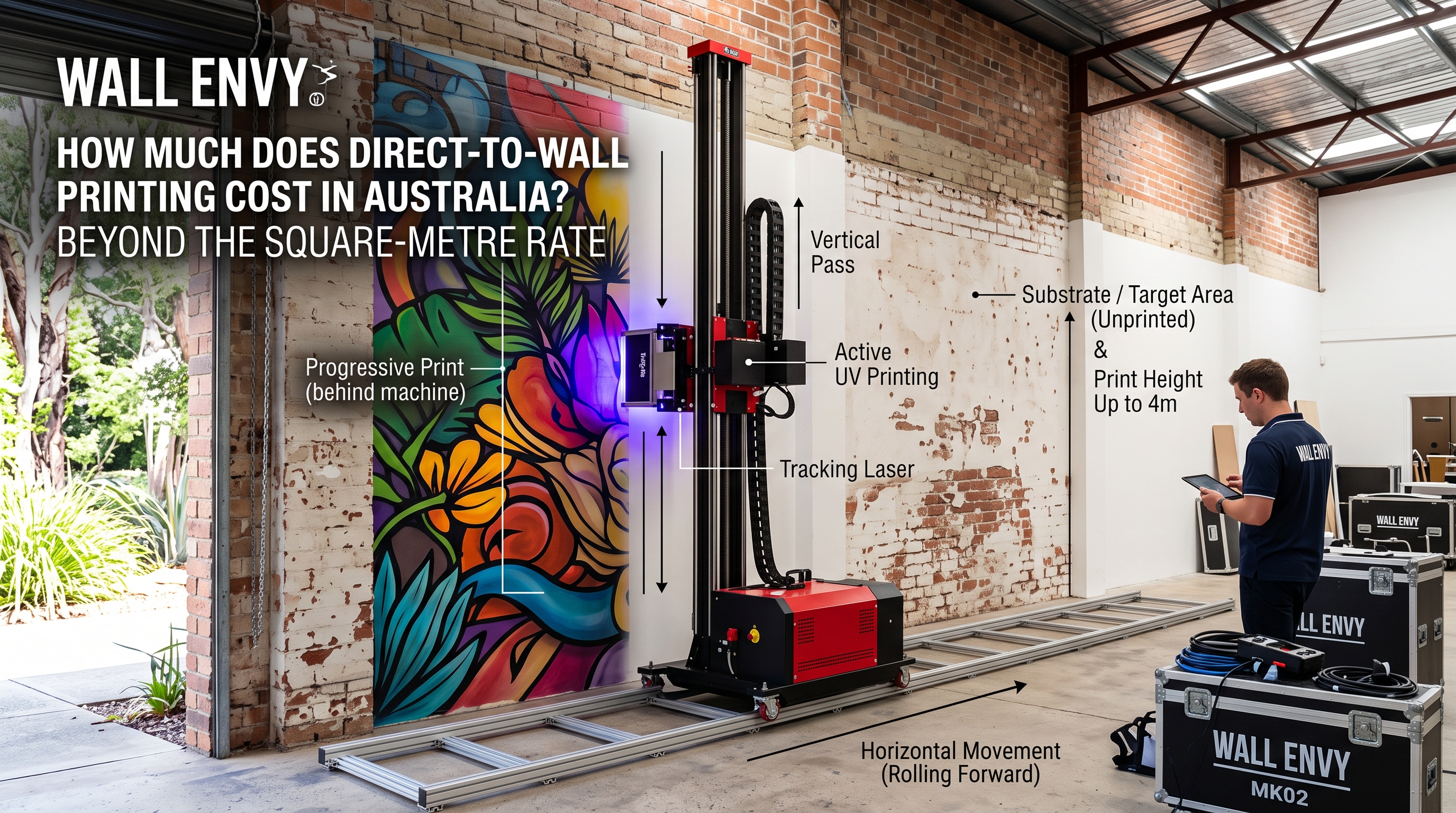
At Wall Envy, we use the MK02 direct-to-wall printer, which uses UV-curable CMYK and white inks. The ink is cured as it is printed, allowing us to print directly onto a variety of prepared surfaces.
What surfaces can a direct-to-wall printer print on?
Here are some of the surfaces we can potentially print on with the right preparation.
Painted plasterboard and gyprock
Painted plasterboard is one of the most straightforward surfaces for direct-to-wall printing.
A sound, properly prepared painted wall provides a good base for a mural, business logo, artwork or branded graphic.
The existing paint colour can also become part of the finished design. However, if the artwork requires accurate colours or includes areas of white, we can use the printer's white ink to create a white underbase where required.
That is particularly useful when printing onto darker or coloured walls.
The condition of the paint is important. Peeling, chalky, flaking or poorly adhered paint should be addressed before printing.
Brick
Brick can create some fantastic results because the natural texture becomes part of the finished wall.
Direct-to-wall printing can be used on suitable brick surfaces, including feature walls and commercial interiors.
However, brick is very different from a smooth plasterboard wall.
Deep mortar joints, large variations in brick depth, loose material and excessive surface irregularities can affect the print.
The MK02 uses sensors to help maintain the appropriate print distance from the surface, but there are practical limits to how much variation any wall printer can accommodate.
This is where an on-site assessment becomes important.
A textured brick wall doesn't need to be perfectly flat, but it does need to be suitable for the printer to travel across safely and consistently.
Concrete
Concrete is another surface that can be suitable for direct-to-wall printing.
Concrete is another surface that can be suitable for direct-to-wall printing.
This opens up some interesting possibilities for:
warehouses
cafés
restaurants
gyms
retail spaces
offices
architectural feature walls
industrial spaces
The concrete needs to be sound and free from loose dust, contaminants and other conditions that could affect ink adhesion.
Very rough or heavily damaged concrete may require preparation before printing.
Render
Rendered walls can potentially be printed on, provided the render is sound and the texture isn't excessive.
Fine to moderate texture can sometimes create an interesting visual effect in its own right.
However, heavily textured or uneven render can make detailed artwork more difficult to reproduce accurately.
For that reason, we look at the actual wall rather than simply saying that all rendered surfaces are suitable.
Tiles
Tiles are another interesting application.
Suitable ceramic or other stable tiled surfaces can potentially be printed directly, making them useful for areas such as:
- bathrooms
- kitchens
- cafés
- restaurants
- retail spaces
- commercial fit-outs
The surface needs to be clean and suitable for ink adhesion.
Grout lines and deep joints also need to be considered when planning the artwork.
For a tiled feature, the design can either work with the existing tile pattern or be positioned so that important elements of the artwork aren't placed across difficult areas.
Timber and wood
Direct printing onto timber and wood can produce a very different result from printing onto a painted wall.
Depending on the timber and finish, the natural grain can remain visible through parts of the design.
This can be particularly effective for:
- feature walls
- shop fit-outs
- hospitality interiors
- signage
- decorative panels
- architectural features
The timber needs to be stable, clean and appropriately prepared.
Painted or coated timber should also be assessed to make sure the existing finish is suitable.
MDF and other sheet materials
Direct-to-wall printing isn't necessarily restricted to walls that are already part of a building.
Suitable sheet materials such as MDF can potentially be printed before or during installation.
This can be useful for feature panels, cabinetry components, signage and custom interior elements.
The key is making sure the material is stable and the surface is suitable for the ink and the printing process.
Glass
Glass can also be printable with the appropriate preparation.
This creates some interesting possibilities for interior design, branding and decorative applications.
Because glass is non-porous and has a very smooth surface, surface preparation and ink adhesion become particularly important considerations.
For applications where durability is critical, we assess the specific glass surface and intended use before recommending a printing solution.
Metal
Suitable metal surfaces can potentially be printed directly, particularly for interior decorative or branding applications.
Again, the existing coating or finish is important.
Bare metal, powder-coated surfaces and painted metal can behave differently, so we don't treat every metal surface as being the same.
For commercial projects, we'll assess the surface and intended environment before confirming the application.
What about dark walls?
This is where white ink becomes particularly useful.
The MK02 uses CMYK + white ink, allowing white to be printed as part of the design or used as a white underbase beneath other colours.
Without white ink, printing a bright image onto a dark surface can produce very different results because the colour of the wall can influence the final appearance.
With a white underbase, we can create a more controlled foundation for the colours above it.
This is particularly useful for:
- dark feature walls
- black walls
- coloured walls
- corporate branding
- logos
- artwork containing white
- high-contrast designs
The amount and use of white ink depends on the artwork and the surface, so it is something we consider during the design and quoting process.
What surfaces aren't suitable?
This is just as important as knowing what we can print on.
Direct-to-wall printing isn't magic.
A wall printer still needs a suitable surface to work with.
Problems can include:
- loose or flaking paint
- unstable surfaces
- excessive dust
- greasy or contaminated surfaces
- severe moisture problems
- extremely uneven surfaces
- deep texture or large changes in surface height
- surfaces that cannot safely accommodate the printer
- areas obstructed by permanent fixtures
In some situations, the surface can be prepared first.
In others, printing directly onto the existing surface simply isn't the right solution.
We'd rather tell you that before the job starts than discover it when we're standing in front of the wall.
Does the wall need to be perfectly flat?
No.
But there is a difference between texture and extreme unevenness.
The MK02 uses sensing technology to help maintain the correct relationship between the printhead and the surface as it moves.
That means it can accommodate some variation in the wall.
However, there are physical limits.
A heavily textured wall, deep brick joints, major changes in surface depth or damaged areas can affect print quality and machine operation.
That's why we don't recommend judging a wall's suitability from a single specification or photograph alone.
For larger projects, we'll assess the actual surface and the proposed printable area.
What about corners, ceilings, floors and obstacles?
This is one of the areas where direct-to-wall printing is different from simply applying wallpaper or a vinyl graphic.
The printer needs physical clearance to operate.
The MK02 has specific working clearances around the printable area, including space required at the top, bottom and sides of the machine.
This means the entire wall isn't necessarily printable right up to every edge.
Things such as:
- ceilings
- floors
- adjoining walls
- doorways
- windows
- pipes
- conduits
- power points
- fixtures
- permanent obstacles
all need to be considered.
We've put the detailed measurements and planning information on our Technical Specifications page so builders, designers and commercial clients can see what needs to be allowed for before a project begins.
What about floors?
The same technology can also be used for direct-to-floor printing, depending on the surface and project requirements.
Suitable flooring applications can include certain tiles, concrete and other stable surfaces.
Floor printing needs a different approach from wall printing because the surface is exposed to foot traffic, cleaning and wear.
For that reason, the intended environment is an important part of deciding what is suitable.
A decorative floor graphic in a private interior is very different from a heavily trafficked commercial entrance.
We assess the application, surface and expected use before recommending the right approach.
Our Services →
Can you print a mural onto an existing wall?
Yes — and that's one of the big advantages of direct-to-wall printing.
Instead of producing a separate sheet of wallpaper or vinyl and applying it to the wall, the image is printed directly onto the existing surface.
That means you can create:
- feature walls
- murals
- business branding
- company logos
- artwork
- school murals
- café and restaurant graphics
- retail graphics
- office interiors
- decorative architectural features
The wall itself becomes the finished canvas.
What happens before we print?
We don't simply arrive with a printer and start printing.
For a typical project, we'll look at:
1. The wall
What is the surface made from and what condition is it in?
2. The artwork
Is the artwork suitable for the required size and resolution?
3. The printable area
How much of the wall can physically be printed?
4. Obstacles and clearances
Are there windows, doors, ceilings, floors, pipes or other objects that affect the print?
5. Surface preparation
Does the wall need cleaning, repairs, priming or another form of preparation?
6. The environment
Is it an indoor or outdoor application? How will the surface be used and maintained?
7. The finished result
We'll create a digital mock-up where appropriate so you can see how the artwork is expected to look in the space before printing begins.
Other FAQs →
So, what can Wall Envy print on?
The simple answer is that direct-to-wall printing can be used on a surprisingly wide range of surfaces.
Depending on the condition and preparation of the surface, the MK02 can be used for applications involving:
Painted plasterboard • brick • concrete • render • tiles • timber • MDF • glass • metal and other suitable stable surfaces.
But the important word is suitable.
Every wall is different.
A smooth painted wall, an old brick wall and a polished concrete surface all behave differently. The best result comes from choosing the right approach for the actual surface rather than trying to force every project into the same process.
That's why Wall Envy takes the time to assess the wall, the artwork and the environment before printing.
If you're considering a mural, business logo, feature wall or commercial branding project, send us a photo of the wall and some information about what you're looking to achieve.
We can then determine whether direct-to-wall printing is suitable and what needs to be considered before the printer arrives.
Want to know more about the technical requirements?
Get in Touch →
How Direct-to-Wall Printing Works →
← Back to Blog